ElevenLabs Reception is $29. Does it get the job done?
When a big voice brand ships a cheap receptionist product, owners will ask the fair question: why not that?
ElevenLabs just put Reception by ElevenAgents (also framed as Reception.ai) in front of small businesses. Basic is $29/month: 75 phone minutes, $0.45/minute overage, one number, one call at a time, plus Google Calendar and Zapier. Plus is $79 and Premium is $199, still Google Calendar-centered. Their page names home services.
That launch is real. The voice layer is real. Calendar booking is real for a lot of shops. We are not going to pretend otherwise, and we are not going to wear their $29 as ours. Know what "books" means before you buy voice alone, and know what else you still own after the stock-keeping unit (SKU) is live.
What owners will hear first
Price travels fast. Someone will say ElevenLabs has AI reception for twenty-nine bucks, and that line will stick. Fair. For a salon, small office, or contractor who runs the day off Google Calendar, voice plus a simple book path can be enough. Reception is aimed at that world, and none of that is fake.
If you run HVAC, plumbing, electrical, or another home-services shop on ServiceTitan, Housecall Pro, or Jobber, the next question is not "does it sound good?" It is "where does the job live when the call ends?"
Calendar booking vs job on the board
A Google Calendar slot is a hold. A job on the board in ServiceTitan, Housecall Pro, or Jobber is the record your dispatcher and techs already trust: customer, address, issue, priority, slot, notes. Reception's public page is calendar-centric. Home services are named, but ServiceTitan, Housecall Pro, and Jobber are not listed as first-class writeback there. Treat native field service management (FSM) writeback as not claimed until they list it. Zapier can bridge later. "Later" is not "the board already has the job."
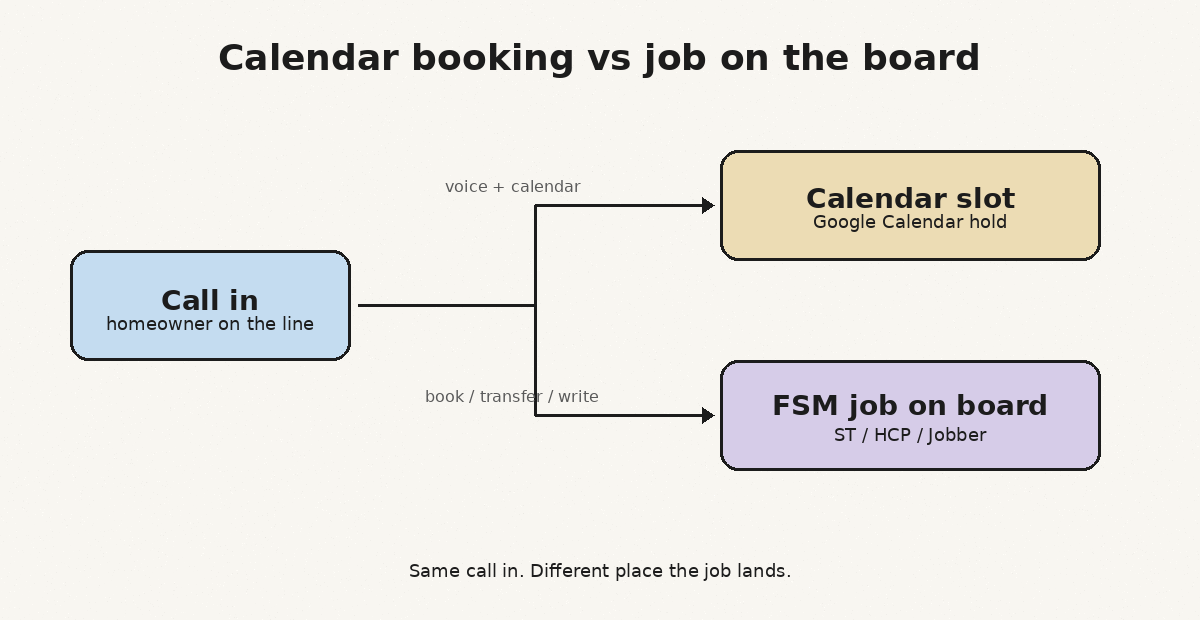
Same call in. One path lands a calendar hold. The other lands a job in the FSM you already run.
Front Desk builds conversational agents for that second path: book when the facts support it, warm-transfer when a person should take it, take a message when that is honest, and write into the FSM with enough discipline to refuse a bad write. Sounding human helps. The board is the scoreboard.
The other half of "why not just $29"
Landing the job is half the story. The other half is what happens after you buy.
Visibility into the conversations. Owners and operators should see what was said on front-office calls, notice patterns across calls, and hear what callers asked for, without guessing from a calendar invite alone. We are not inventing a named analytics product, fake dashboards, or booking-rate claims. Shops that care about the board usually care about seeing those calls clearly enough to coach, adjust rules, and catch misses.
A learning loop with the shop. A $29 voice SKU is easy to treat as set-and-forget. Agents that book, transfer, message, and write into an FSM do not work that way for long. Real calls surface edge cases; prompts and rules need review. The honest loop is iteration with the shop over time, not a one-and-done install and not a claim that machine learning will fix itself. Review the calls, tighten the prompts, and the agent gets better because you and we looked.
White-glove help into their systems. Self-serve calendar plus Zapier is real for shops whose day already lives there. Home-services shops on ServiceTitan, Housecall Pro, or Jobber usually need more than a checkbox. White glove, for us, means human help integrating into the stack they already run and how the day actually moves: dispatch, on-call, what a "book" is allowed to write. It is not "we do everything for free forever." It is help into the systems your crew already trusts.
Why "books" is a coordination word
When two products both say they "book," they may mean two different things. One books a Google Calendar appointment and leaves a transcript. Another ends with a usable job in ServiceTitan, Housecall Pro, or Jobber, with a warm handoff when the agent should not keep the call. Both can be honest. They are not interchangeable on a storm morning when your crew needs the board, not a shared invite waiting for someone to re-enter fields.
Before you buy voice alone, ask: after this call, where does the work live, and who has to touch it before a tech rolls? If you need the job on the board, a way to see the conversations, a setup that tightens from real calls, and help into your real stack, you are shopping a front-office agent stack, not only a voice SKU.
What we are not saying
We are not saying their voice is weak, or that $29 is Front Desk pricing. We are not inventing Front Desk metrics, logos, or live shop claims, and we are not running an Avoca bake-off. We are not pitching a receptionist-only story. The frame is conversational agents: book, transfer, message, FSM writeback, plus visibility into the calls, a learning loop with the shop, and white-glove help into their stack.
Pressure-test on a live call
On a live test call, ask: what happens when two calls hit at once (Basic is one at a time); where the job lives after the call; whether warm transfer works for your on-call flow; whether you can see what was said after a week of real calls and tighten prompts from them; and who helps wire this into the systems you already run versus calendar plus Zapier alone. If the answers are thin on the board, visibility, and wiring, you know what you bought. Fine for a quiet shop. Different from "the board already has the job."
Bottom line
Owners will hear $29. Respect Reception for strong voice, easy setup, Google Calendar booking, and a price that travels. Our line stays shops that need the job on the board: conversational agents that book, transfer, or message, then write into ServiceTitan, Housecall Pro, or Jobber without silent bad writes. Owners should see what was said on those calls. The setup should get better from real calls through review and iteration with the shop. Someone should help integrate into the systems the crew already runs. Voice is the layer. The board, the conversations, and the loop are the outcome.
Home-services picture: front-desk.ai/for/home-services. Live call path: front-desk.ai/demo.
- Block's Dessa sounds human. Here's what it still needs before it answers a shop's phone
- Your Phone Voice Is the First Hello
- Augment the Front Desk. Don't Replace the Team.
- Front Desk now answers on Grok Voice 3. Here's what that means for your callers
- After-hours intake for personal injury firms: the 9pm call
- AI receptionist for personal injury lawyers: a 10-point checklist
- Bilingual legal intake for PI firms shouldn't wait for one person's shift
- Personal injury attorney intake: what Front Desk does for PI firms
- "Google Now Charges for Missed LSA Calls. Answer Inside 20 Seconds."
- "Personal AI Agents Are Calling the Shop. What Changes for Your Phone Line"
- Why Local Businesses Are Switching To AI Phone Agents
- What a ~$10 AI phone does for a contractor (and what it still is not)
- When a New Model Drops, Your Agent Gets Better.
- Your Front Office Is Four Logins.